LiftTrack
The planned Push template and recent workout history: what was intended, and what had already been done.
CASE STUDY · WORKOUT REVIEW
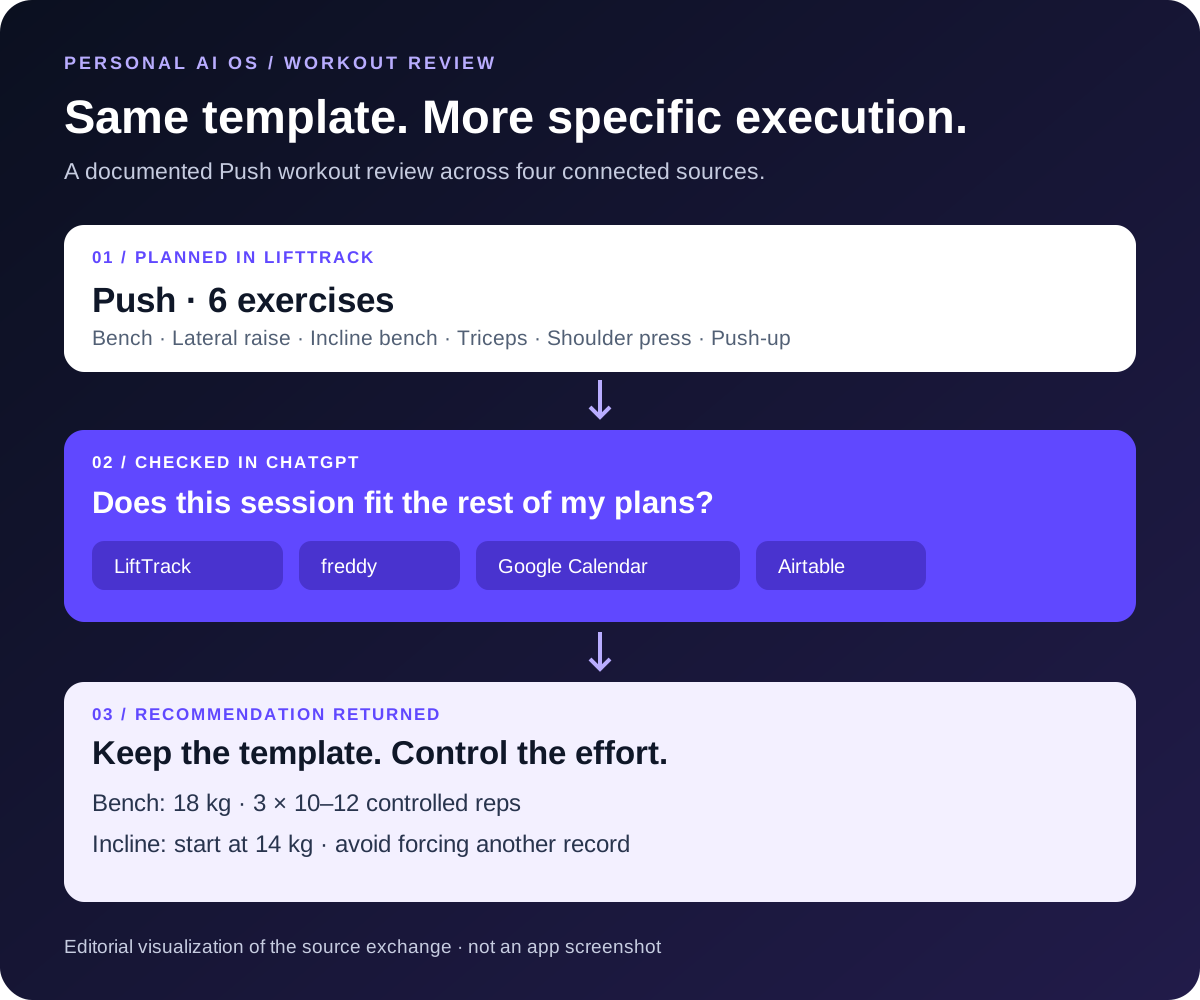
A Push workout was already planned in LiftTrack. I asked my AI coach to check it against my recent training and the rest of my plans.
LiftTrack · freddy · Google Calendar · Airtable
See the workout and concrete recommendations ↓WHAT WAS CHECKED
The visible activity messages report lookups across four connected sources. The response then discusses the template, previous strength sessions, recovery and upcoming training together.
The planned Push template and recent workout history: what was intended, and what had already been done.
Recent activity and recovery context, made available through the connected health-data service.
The surrounding training schedule, including the next running sessions.
Subjective journal context that adds information beyond the workout template.
THE ACTUAL WORKOUT
The LiftTrack screen shows a planned Push session with six exercises. In the reply, the coach lists the following template. Loads are reproduced as displayed in the conversation.
| Exercise | Sets × reps | Load |
|---|---|---|
| Dumbbell bench press | 3 × 10 | 18 kg |
| Lateral raise | 3 × 12 | 4 kg |
| Incline dumbbell bench press | 3 × 10 | 14 kg |
| Triceps extension | 3 × 10 | 8 kg |
| Shoulder press | 3 × 10 | 10 kg |
| Decline push-up | 3 × 12 | Bodyweight |
WHAT CHANGED IN PRACTICE
The answer compared the template with previous performance and the surrounding training schedule. These are specific recommendations from that reply, not a record of a completed session.
The reply references previous bench sets of 18 and 12 repetitions at 18 kg. Its recommendation for the planned session: 3 × 10–12 clean repetitions at 18 kg, rather than repeating a high-repetition effort just because it is possible.
The template load stays. The intended effort becomes more specific.
The previous session is described as including 14 kg × 16 and 16 kg × 13. The recommendation starts with 14 kg, with 16 kg only if the first set is very easy, without aiming to force a new record.
Previous performance informs the recommendation without making every session a progression test.
The response retains 4 kg lateral raises and 8 kg triceps extensions. It describes controlled repetitions for the remaining exercises and technically clean push-ups instead of a maximum-repetition test.
The exercise selection is retained; execution cues refine the plan.
The reply considers a recently completed long run, a planned day without running, a subsequent easy run and a later quality session. It assesses the Push workout as part of that sequence.
The calendar contributes context that the exercise template alone cannot provide.
“Keep the workout” can still come with a specific answer about weight, repetitions and effort.
SELECTED SOURCE EXCERPTS
These are transcribed excerpts from the supplied screenshots, not recreated app screenshots. The original German wording is retained below; English translations are labelled.
01 · USER REQUEST
Für morgen plane ich ein Push Workout. Überprüfe das geplante Training (siehe Template) gegen meine sonstigen Pläne.
freddy · Google Calendar · LiftTrack · Airtable
02 · OPENING OF THE RESPONSE
Ja — Push morgen passt grundsätzlich gut, aber mit einer klaren Einschränkung bei der Lastprogression.
03 · CONCLUSION EXCERPT
Push morgen: ja. Template: ja. Intensität: moderat. Keine Änderung am Workout nötig.
HOW THE ANSWER BECAME SPECIFIC
The response went beyond confirming that a workout existed. This is an editorial summary of its reasoning, with personal details omitted:
The useful output was a decision about effort within an existing workout.
EVIDENCE & PRIVACY
The screenshots document a scheduled workout, a user request, visible connector activity messages and the resulting recommendation. They do not independently verify every retrieved record or establish that the recommendation was optimal.
This is a workflow case study. No completed workout, training benefit or clinical outcome is demonstrated. The recommendations describe this individual exchange and are not a general training prescription.
Selected exercise details and conversation excerpts are published alongside an editorial diagram. Private health and journal information, exact dates and underlying records are omitted. Full screenshots are not included in this case study’s public assets.
The recommendation remained advice for the user to assess. This exchange does not demonstrate an automatic write to LiftTrack, Garmin or the calendar.